

Benefits for Individuals
- Engaging video-based content
- Learner dashboard included
- Instant access after payment
- Free course retakes
- Shareable digital certificate



The Echo3 online Emergency First Aid at Work (EFAW) course trains your staff to act correctly in life-threatening emergencies such as cardiac arrest, heart attack, stroke, choking and serious bleeding. Echo3’s online EFAW course is CPD-accredited, completed entirely online, and delivers a digital certificate valid for three years.
Every second counts in a medical emergency. Survival rates for out-of-hospital cardiac arrest can jump from around 5% to as high as 70% when CPR is started and an automated external defibrillator (AED) is used within the first few minutes. A trained first aider can keep an injured or ill person alive, stop a condition getting worse, and support recovery until paramedics arrive.
Beyond meeting your legal obligations, EFAW training reduces workplace risk and lost-time incidents, demonstrates a clear duty of care to employees, builds staff confidence, and can be the difference between a minor incident and a fatal outcome.
This online EFAW course covers the core skills every workplace first aider needs:
The Health and Safety (First-Aid) Regulations 1981 don’t set specific training numbers or levels. There are no hard-and-fast rules on how many staff you need to train, or which qualification they require.
What the regulations do require is that every UK employer provides “adequate and appropriate” first aid equipment, facilities and trained personnel.
What counts as “appropriate” for your workplace is determined by your First Aid Needs Assessment, which considers:
The Health and Safety Executive (HSE) recommends at least one face-to-face trained first aider for employers with 5 to 50 staff. As best practice, factor in shift patterns so a first aider is always on site.
For workplaces with fewer than five staff, an online EFAW course is often appropriate. Online training also works well when you want all staff to have basic skills for example, customer-facing roles, occasional lone workers, or sports clubs and gyms.
The best approach: start with HSE guidance, then apply common sense based on your specific business circumstances.
EFAW vs FAW. The main difference between Emergency First Aid at Work (EFAW) and First Aid at Work (FAW) is scope. EFAW covers life-threatening emergencies only. First Aid at Work (FAW) also covers non-life-threatening situations where an ambulance isn’t required — such as minor cuts, bruises, sprains and other common workplace injuries. FAW is usually the better fit for higher-risk workplaces or first aiders who need broader cover.
Working with children? If your staff work with babies, children or young people. In nurseries, schools, sports clubs or childcare settings see our Paediatric First Aid Course instead. It covers age-specific CPR, choking and emergency response for infants and children.
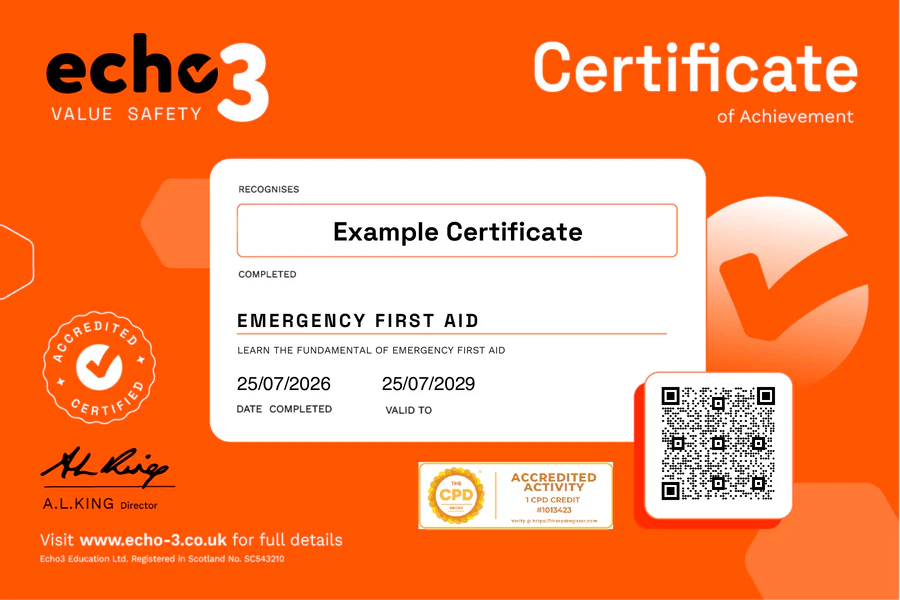
On successful completion, learners receive a CPD-accredited Emergency First Aid at Work certificate, issued digitally and stored securely in their Echo3 account.
The certificate is widely recognised across the UK and accepted for audits, compliance checks and contractor pre-qualification. It is valid for three years in line with HSE guidance, and can be downloaded, printed or shared instantly.

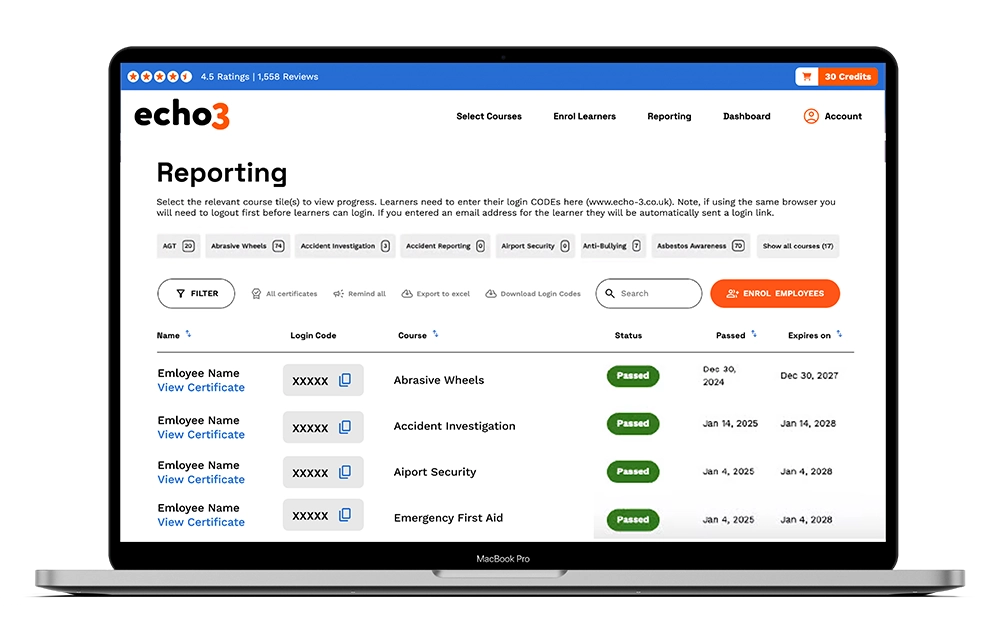
Echo3 delivers online EFAW training built for the way modern workplaces operate. From a single dashboard, you can:
Combine this course with our other workplace first aid training to cover every scenario your team might face:
All Echo3 courses can be purchased with Echo3 Training Credits, giving you flexible, pre-paid access across your whole workforce.
A CPD accredited certificate, emailed the moment you pass. Employers, agencies and auditors scan the QR code to check it on the spot.
Written in accordance with the Health and Safety (First-Aid) Regulations 1981.
Get Certified · £10.00 + VATAt Echo3 we design our courses around how people actually learn. The content is concise, free from unnecessary repetition, and supported by motion graphics to help explain key concepts. This enables workers to train efficiently, stay engaged, and ultimately stay safe at work.

An EFAW course is a workplace first aid qualification that trains employees to respond to life-threatening emergencies such as cardiac arrest, heart attack, stroke, choking, serious bleeding and unconsciousness. EFAW stands for Emergency First Aid at Work. It meets the requirements set out in the UK Health and Safety (First-Aid) Regulations 1981 for most small, low-risk workplaces, and the certificate is valid for three years.

EFAW stands for Emergency First Aid at Work a workplace first aid qualification focused on life-threatening emergencies.
The level of training varies depending on the hazards and risks in your workplace.
First-Aid Regulations 1981 state that employers must provide “such number of suitable persons as is adequate and appropriate in the circumstances for rendering first-aid to his employees if they are injured or become ill at work”
For some common workplaces Health and Safety Executive detail what they consider ‘adequate and appropriate’ in these case studies.
Typically to become a ‘qualified’ workplace first aider you should take an 18-hour FAW course or 6-hour EFAW course.
Blended learning where online and face to face training are combined is ‘acceptable’, see [Point 62. HSE Guidance on First Aid regulations]
Your first aid needs assessment may also determine for a variety of reasons eg, a small business under 25 employees that a qualified first aider is not required. In this situation an online First Aid training may be deemed more suitable than no training.
The Echo3 EFAW certificate is valid for 3 years. The Echo3 system enables administrators to change the validity period.
UK Safety laws require appropriate training. It is the responsibility of employers to determine what training and refresher duration is appropriate. This is done through the risk assessment process.
Yes. Annual online EFAW refresher training is one of the most common uses of this course, helping trained first aiders keep their skills sharp between full recertifications.
No. For an SIA Licenses you need to take a 6 hour face-to-face EFAW course.
The first step in treating a medical emergency in the workplace is to conduct a primary survey. A first aid primary survey involves observing for dangers to you and the victim, checking the level of consciousness, examining airways for obstruction, checking respiratory response and circulation.
You cannot help a victim if you become a victim yourself so it is imperative that you evaluate the situation before attempting to administer first aid. Evaluating the situation is the first step in the primary survey.
You need to be aware of any dangerous factors which might present themselves to you or the patient such as traffic, gas, petrol or chemical spills, live electrical wires, fire or falling objects.
There are also human factors, such as bystanders in the way, an uncooperative patient or an assailant who may have inflicted the injuries on the victim. If any of these factors are present, stay well back until the police are able to control the situation.
You should continue to be aware of changes to the situation or environment that could present danger to you or the patient and if there are dangers, which you cannot alleviate, then STAY CLEAR and call the emergency services. Remember to never put yourself in harm’s way.
EFAW covers life-threatening emergencies only. FAW (First Aid at Work) is more comprehensive and covers both life-threatening and non-life-threatening injuries and illnesses, making it the usual choice for higher-risk workplaces.
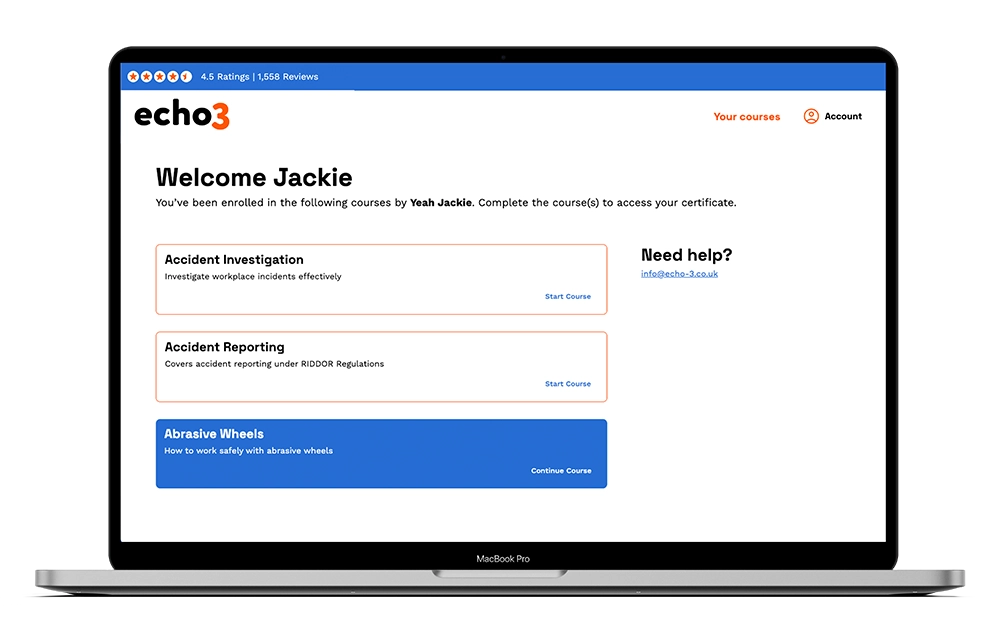
Yes. The Echo3 dashboard allows bulk enrolment, progress tracking and certificate management across your whole organisation.





 Guaranteed Safe & Secure checkout managed by Stripe & Paypal






Have any questions about our training or services?
Email us at info@echo-3.co.uk today!
Get in touch