

Benefits for Individuals
- Engaging video-based content
- Learner dashboard included
- Instant access after payment
- Free course retakes
- Shareable digital certificate
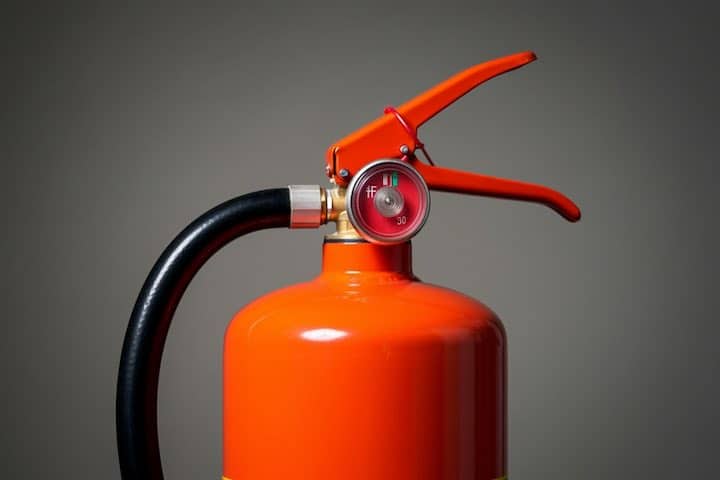



This online Fire Extinguisher Training course provides essential knowledge and confidence to use fire extinguishers safely and effectively in the workplace. Designed for UK businesses, this fire extinguisher course online supports legal compliance while improving workplace fire safety.
Fire extinguishers can stop small fires from becoming serious incidents, but only when used correctly. Using the wrong extinguisher, such as water on oil or electrical fires can rapidly worsen the situation. This training ensures learners know how to respond quickly, safely, and with the correct equipment.
Fire safety law requires employers across the UK to provide appropriate firefighting equipment including fire extinguishers where necessary. And ensure staff are trained in its use:
This course supports compliance across all UK home nations by delivering practical fire safety training that helps organisations meet their legal responsibilities.
Learners gain a clear understanding of when it is safe to use a fire extinguisher, how to identify different extinguisher types (water, CO₂, foam, powder), and how to operate them using the PASS technique. The course also covers fire classifications, common risks, and basic inspection and maintenance requirements to ensure equipment is ready for use.
Fire extinguisher training is essential for protecting people, property, and business operations. Trained staff can respond quickly in an emergency, helping to reduce injury, limit damage, and improve overall safety.
Incorrect extinguisher use can make fires worse. For example, using water on oil fires can cause flames to spread, while using water on electrical equipment can create serious shock risks. Fire services regularly report that many small fires could be controlled early with correct training and equipment knowledge.
This online fire extinguisher training UK course is suitable for employees in all sectors, including construction, utilities, warehouses, and office environments. It is ideal for anyone who may need to use a fire extinguisher, including supervisors, fire marshals, and general staff. No prior experience is required.
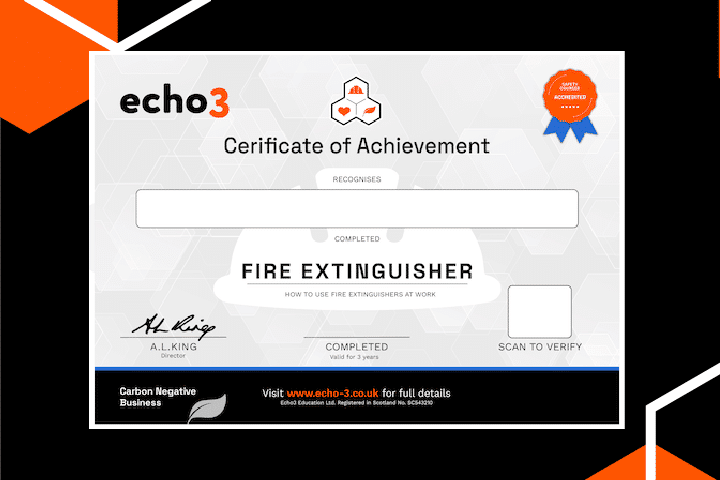
After completion, learners receive a recognised fire extinguisher certificate for workplace compliance, site inductions, contractor approval, and health and safety audits.
Echo3 delivers fully online fire extinguisher training designed for modern workplaces. Employers can enrol staff, track progress in real time, and manage compliance in one system.
This course can also be combined with Fire Marshal Training, Fire Safety Awareness, Office Safety, and Risk Assessment courses to build a complete health and safety training programme. All training is available via Echo3 Credit, making it scalable, flexible, and cost-effective.
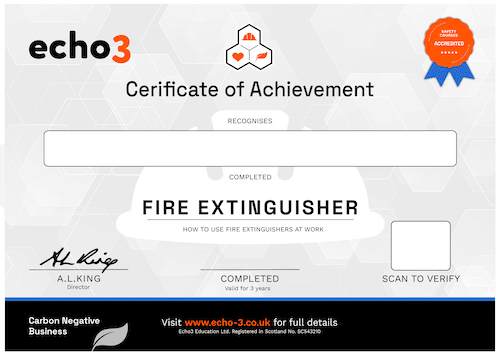
Your certificate is emailed the moment you pass. Employers, agencies and auditors scan the QR code to check it on the spot.
Written in accordance with the Regulatory Reform (Fire Safety) Order 2005, the Fire (Scotland) Act 2005, the Fire Safety (Scotland) Regulations 2006 and the Fire and Rescue Services (Northern Ireland) Order 2006. Last updated January 2025.
Get Certified · £10.00 + VATAt Echo3 we design our courses around how people actually learn. The content is concise, free from unnecessary repetition, and supported by motion graphics to help explain key concepts. This enables workers to train efficiently, stay engaged, and ultimately stay safe at work.
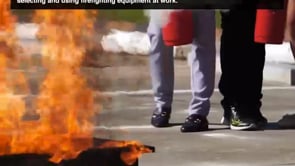
The Echo3 online Fire extinguisher training teaches employees how to safely identify, select, and use the correct type of fire extinguisher in the workplace. It helps staff respond quickly to small fires before they escalate into serious incidents. Certificate on completion.
This Fire Extinguisher training provides the knowledge needed to tackle small fires at work. If you have the requirement to tackle small fires at work then appropriate training is required.
Roles that have this duty will usually be determined during a risk assessment. Often those working as a Fire Warden or Fire Marshal will benefit from this knowledge. Or it may be part of general Fire Safety responsibilities in workplaces where the fire risk is elevated.
Upon completion of this course, you will:
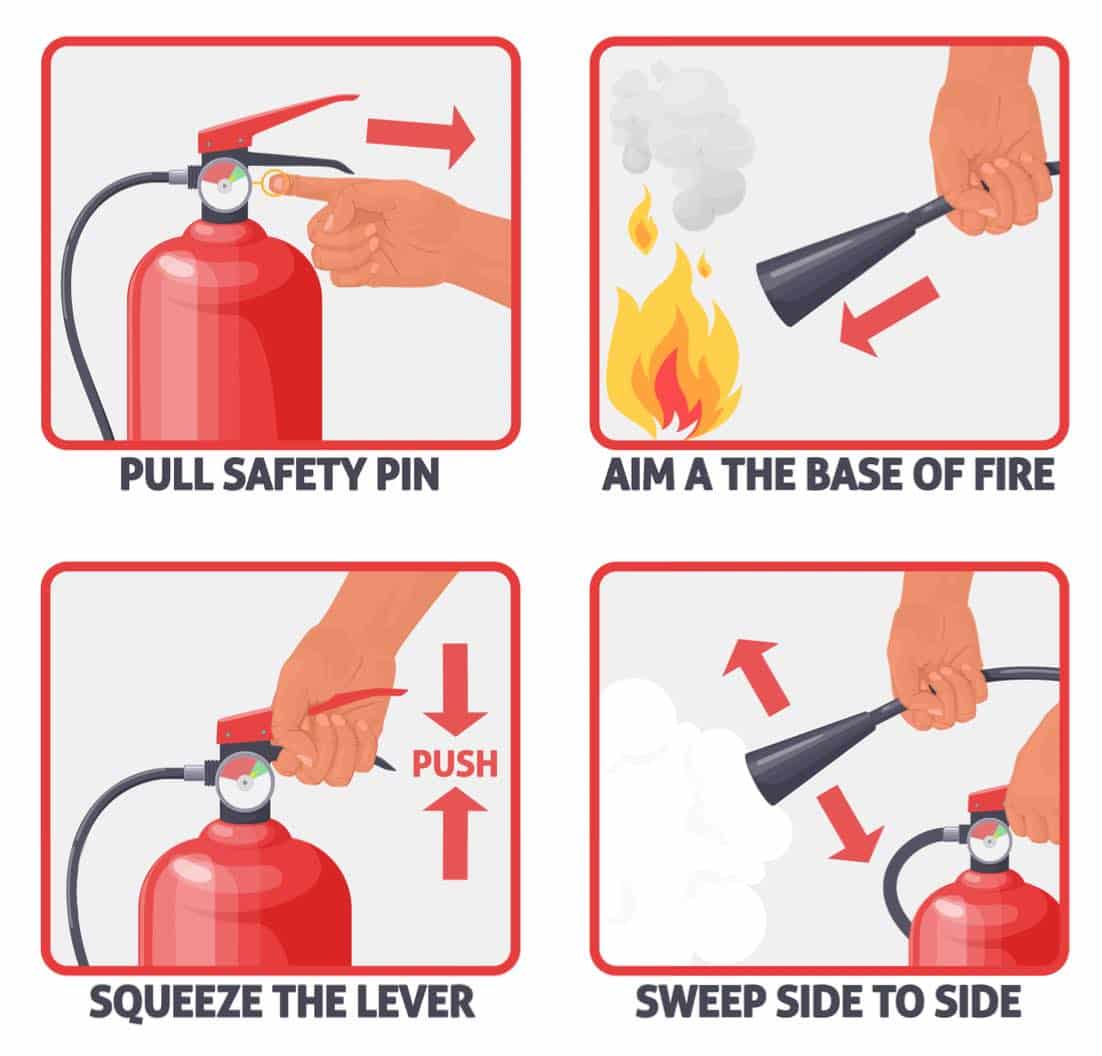
PASS stands for Pull, Aim, Squeeze, and Sweep. It is the standard method for operating a fire extinguisher safely and effectively in an emergency.
Proper usage techniques are essential for effective firefighting.
Fire blankets are crucial tools in many fire safely kits. Whenever fire blankets are present it is essential to understand how to use them effectively. Made from flame retardant material they work by depriving the fire of oxygen and extinguishing the fire. It’s important to remember that fire blankets are designed for small fires only.
Keep in mind trying to tackle larger fires with a blanket can be both dangerous and ineffective. For larger fires it is much better to immediately raise the alarm and evacuate the building.
Fire Blankets are often used for kitchen fires, where oil and grease can fuel flames rapidly. They can also be used for smothering small fires involving electrical equipment or appliances.
Using a fire blanket is easy.
When confrontment with a small fire, remember the acronym PASS. Pull, aim, Squeezer Sweep.
First pull the fire blanket out of its packaging. Then, aim it at the base of the flames, covering them completely. Next, gently squeeze the blanket to release any trapped air, ensuring optimal smothering. Finally sweep the blanket across the flames extinguishing them entirely.
Finally, remember to regularly inspect you fire blankets for signs of damage or wear and replace it as needed to ensure its reliability in an emergency. Ensure a fire blanket is readily accessible to protect your home or business.
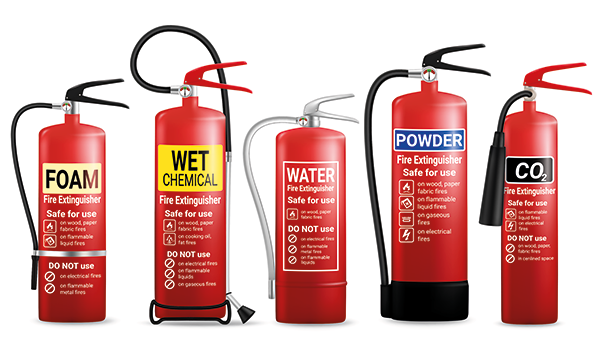
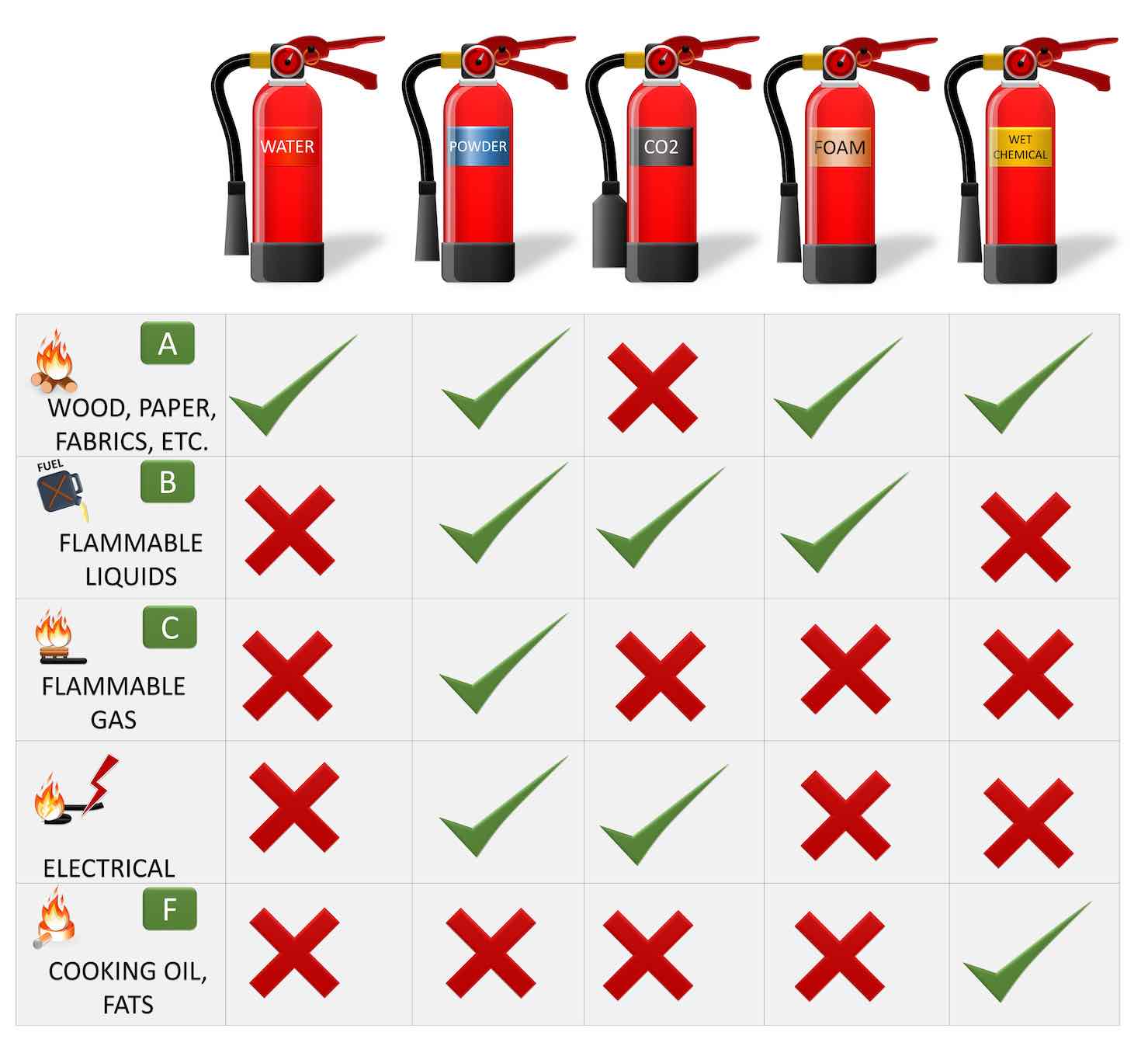
Fire extinguishers have red metal bodies with a coloured band to identify their type. There are five types of extinguishers commonly in use for the different fire classes.
Carbon dioxide
These extinguishers have a black band and a black funnel shaped hose. Use for electrical, class B and C fires. Don’t use in small rooms.
Water
Water extinguishers have a solid red body. Use on class A fires only.
Dry powder
Dry Powder extinguishers have a blue band. Use for all fires except class F.
Foam
Foam extinguishers have a cream band. Use on class A and B fires.
Wet Chemical
These extinguishers have a yellow band. Use on class A and F fires.
Using some extinguisher types on the wrong fire class may spread the fire.
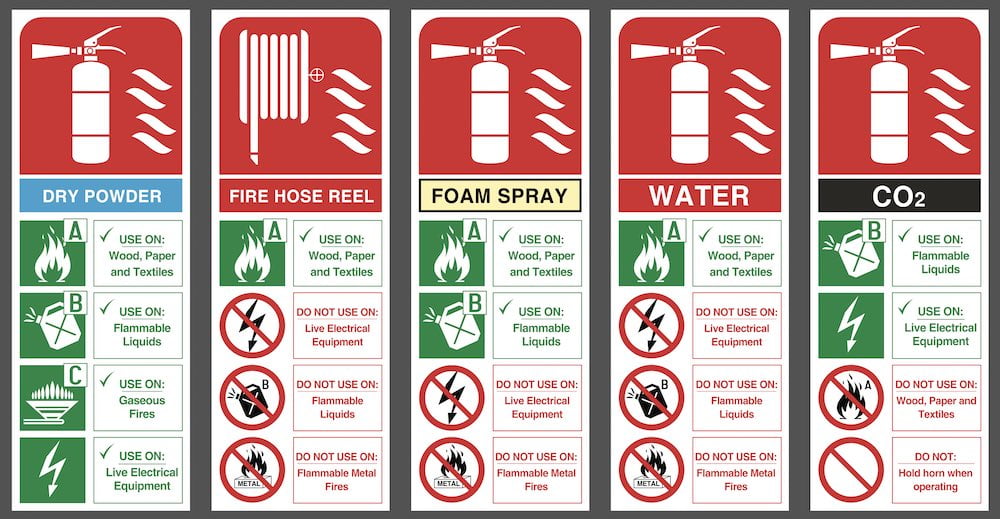
Fires are grouped into ‘classes’ based on the fuel they burn. The different classes are called Class A, B, C, D, F and Electrical.
Knowing the class means the correct fire extinguisher can be used.
Class A: Class A fires burn flammable solids such as paper, wood, coal, plastic, furniture, textiles.
Class B: Class B fires burn flammable liquids such as paint, petrol, oil, diesel.
Class C: Class C fires burn gasses such as natural gas, hydrogen, propane and butane.
Class D: Class D fires burn metals such as potassium, aluminium, and magnesium.
Class F: Class F fires are fires that involve cooking oils and fats. Fires of this class can occur in food premises.
Electrical Fires: This type of fire does not have its own class because fires involving electrical equipment can fall into any of the other classes.
No prior experience is required. The course is designed for beginners and provides clear, practical guidance suitable for all workplace roles.
As an online course, it can typically be completed around 30 minutes, allowing learners to study at their own pace and revisit sections when needed.
Yes. The certificate can be used as evidence of fire safety training for workplace compliance, health and safety audits, contractor requirements, and site inductions.





 Guaranteed Safe & Secure checkout managed by Stripe & Paypal




Have any questions about our training or services?
Email us at info@echo-3.co.uk today!
Get in touch