
Benefits for Individuals
- Engaging video-based content
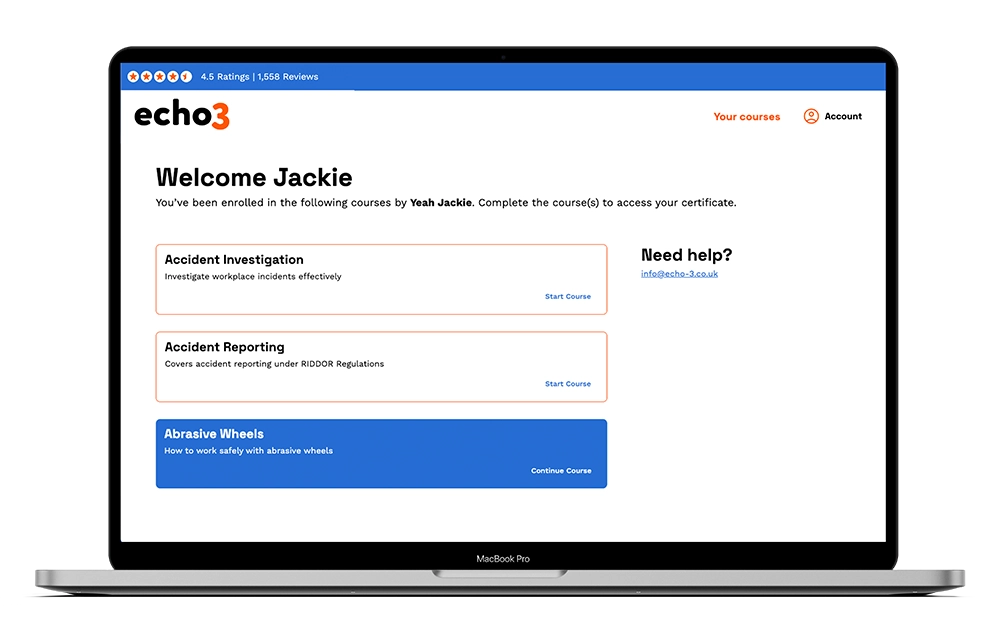
- Learner dashboard included
- Instant access after payment
- Free course retakes
- Shareable digital certificate

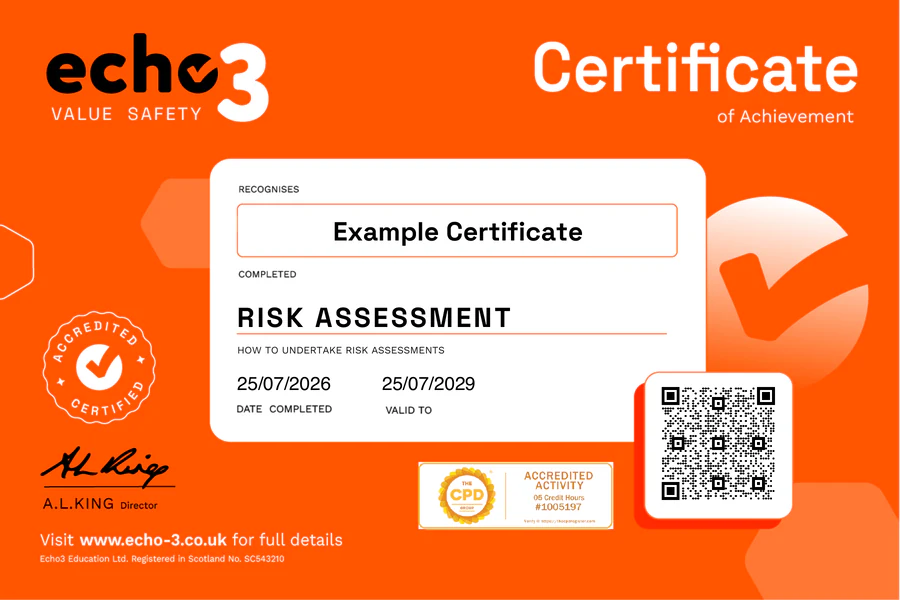



The Echo3 Online Risk Assessment Course is a CPD-accredited training designed for employers, managers, supervisors, and anyone responsible for workplace safety in the UK. This online risk assessment training equips learners with the practical skills to identify hazards, evaluate risks, and implement effective control measures, helping organisations comply with UK health and safety law and protect employees from injury or illness.
Risk assessments are a legal and practical cornerstone of workplace safety. The Health and Safety Executive reports that an estimated 680,000 workers sustained non-fatal injuries in 2024/25, while around 1.9 million employees experienced work-related ill health, showing that hazards remain a significant concern despite safety improvements. Learning to conduct and understand risk assessments enables organisations to focus on the most critical risks, prevent accidents, and reduce costly workplace injuries.
Enhance your workplace safety knowledge further by exploring related courses, such as our Online Fire Marshal Course or Health and Safety For Managers Training, to create a comprehensive safety programme.
This CPD-accredited online course provides nationally recognised certification and aligns with UK health and safety regulations. Staff gain confidence to proactively manage workplace risks, support legal compliance, and contribute to a safer working environment.
Completing the course demonstrates a strong commitment to health and safety and provides proof of competency for audits, inspections, and compliance documentation.
Delivered entirely online, this course features short, engaging modules designed to teach risk assessment step by step. Each lesson focuses on practical techniques for identifying hazards, evaluating risks, and recommending controls without overloading learners with technical legislation.
Flexible and self-paced, the course can typically be completed in around 60 minutes, making it suitable for individuals and teams with busy schedules.
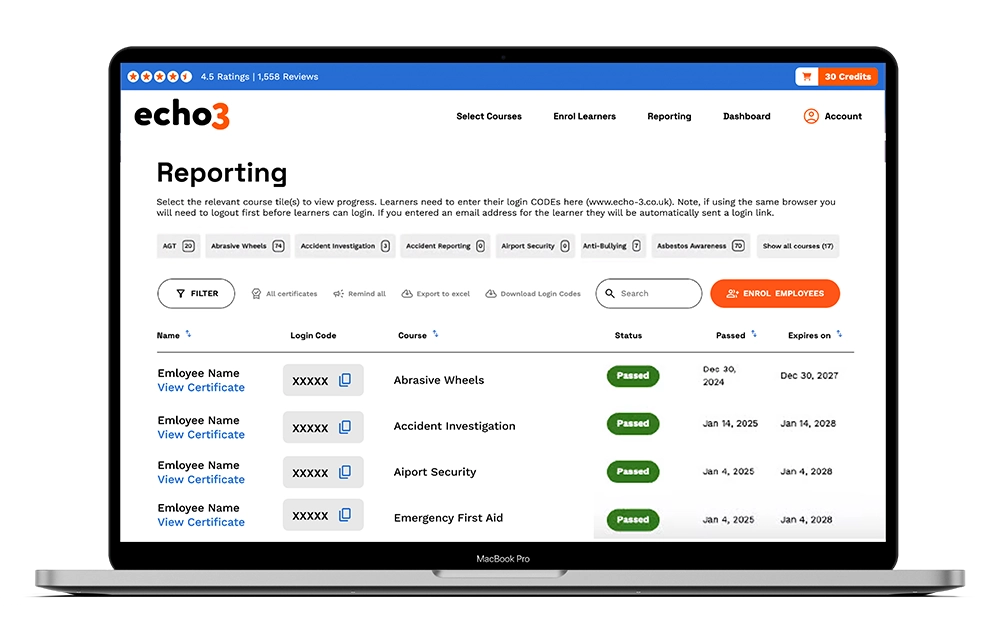
Upon successful completion, learners receive a verifiable CPD-accredited certificate via email, serving as proof of competency for compliance records and workplace safety documentation. Employers can monitor enrolment and progress through the Echo3 Learning Management System, ensuring risk assessment training is fully documented and up to date.
Protect your team, maintain legal compliance, and build essential health and safety skills with the Echo3 Online Risk Assessment Course. This practical, focused training provides a strong foundation in risk assessment principles, empowering employees to create safer and more productive workplaces.
For a deep safety programme, consider pairing this course with our Online First Aid Training or Fire Safety Courses to cover more aspects of workplace safety.
At Echo3 we design our courses around how people actually learn. The content is concise, free from unnecessary repetition, and supported by motion graphics to help explain key concepts. This enables workers to train efficiently, stay engaged, and ultimately stay safe at work.
An Online Risk Assessment Course teaches employees and managers how to identify workplace hazards, evaluate risks, and implement control measures to prevent accidents and comply with UK health and safety law. This CPD-accredited training can be completed entirely online, making it flexible for busy professionals.
This course is ideal for employers, managers, supervisors, health and safety officers, and anyone responsible for workplace safety. It’s also suitable for staff who want to gain recognised CPD-accredited credentials in risk assessment.
To get a clear understanding of the risk assessment process you need to understand what is meant by the terms ‘Hazard’ and ‘Risk’ in the lexicon of health and safety. These are terms that are often used interchangeably but actually have very distinct meanings.
What is a Hazard?
Hazards are anything that can cause harm, damage or adverse health effects to people in the workplace.
A flammable substance is an example of a HAZARD. If the flammable substance is near an open flame, then obviously the RISK of an unplanned fire is higher. If it is stored safely the risk is much lower.
No fuel station can avoid the ‘hazard’ of flammable substances. However, effective measures are in place to ensure that fires at fuel stations are very rare. These measures lower the ‘risk’.
Some activities bring multiple ‘hazards’. When working on a ladder, staff could fall and be injured. So, falling is a hazard. They could also drop an object from height and harm a co-worker. This is also a hazard.
When hazards are understood, steps can be taken to reduce the associated risks. For example, tool tethering will reduce the risk of a dropped object. Appropriate ladder safety training will reduce the risk of falling.
What is a risk?
Risk, in health and safety, is the likelihood or chance of a person being injured or receiving an adverse health effect due to a specific hazard.
It’s useful to keep these definitions clear and separate in your mind when considering risk assessments. They are often confused which makes risk assessments harder to consider.
For example, you might have heard offices referred to as low-risk workplaces. Technically, offices are low-hazard workplaces because staff are not exposed to many hazards, such as climbing ladders or handling chemicals.
However, a particular office may have a faulty fire alarm. This means that, if there is a fire, there is a high risk that staff will not evacuate quickly enough because they won’t hear the alarm. So, in this example, the office may be low-hazard, but it is not low risk.
To support you in reducing risks to the lowest reasonably practicable level, the Hierarchy of Control can guide you in determining how to implement feasible and effective control solutions. The hierarchy starts with the control methods that are potentially more effective and protective then moves on to less effective measures.
The Hierarchy of Control flows is as follows:
Risk assessment is a process where hazards are identified, and common-sense steps are taken to reduce the chance of the hazard causing an incident.
The risk assessment process has 5 steps.
Yes. Upon successful completion, learners receive a verifiable CPD-accredited certificate via email. This certificate can be used for compliance records, audits, and evidence of competency in workplace health and safety.
Yes. UK law, including the Management of Health and Safety at Work Regulations, requires employers to carry out ‘suitable and sufficient’ risk assessments. Completing this CPD-accredited online course ensures your staff are trained and competent to meet these legal obligations.
Absolutely. The Echo3 Learning Management System allows employers to enrol multiple staff members, track progress, and store certificates securely, making it ideal for team training and workplace compliance programmes.
Yes. The course is designed to cover general workplace risk assessment principles applicable across industries, including offices, manufacturing, retail, education, and healthcare.





 Guaranteed Safe & Secure checkout managed by Stripe & Paypal





Have any questions about our training or services?
Email us at info@echo-3.co.uk today!
Get in touch