

Benefits for Individuals
- Engaging video-based content
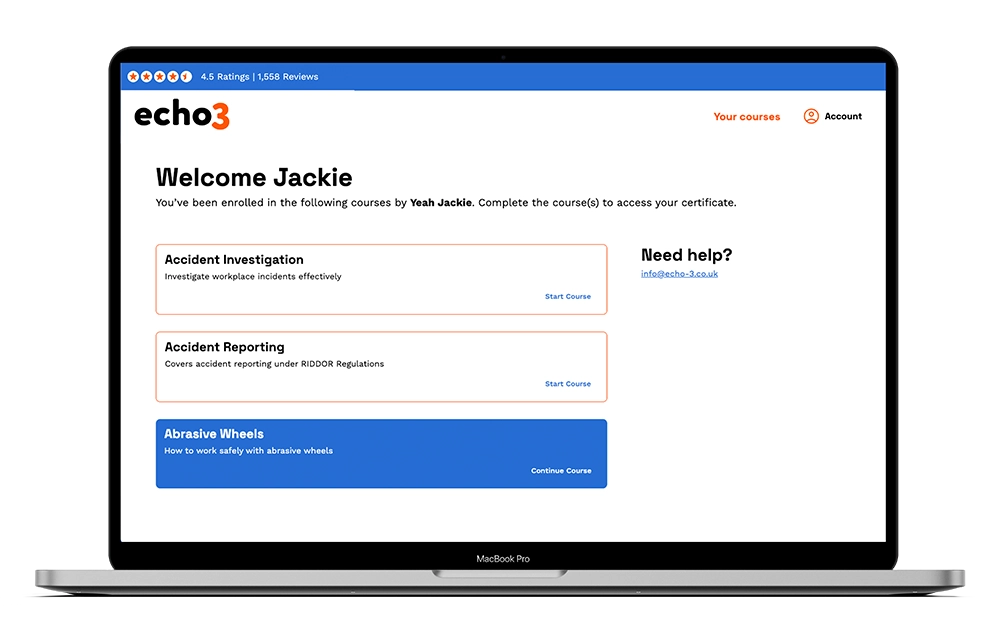
- Learner dashboard included
- Instant access after payment
- Free course retakes
- Shareable digital certificate
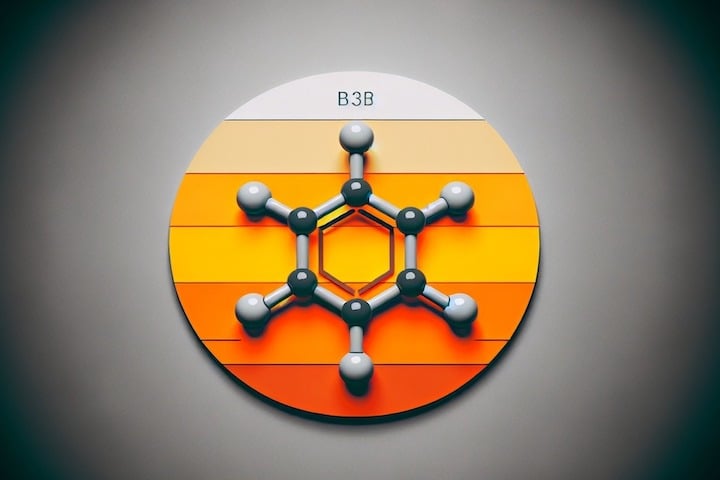
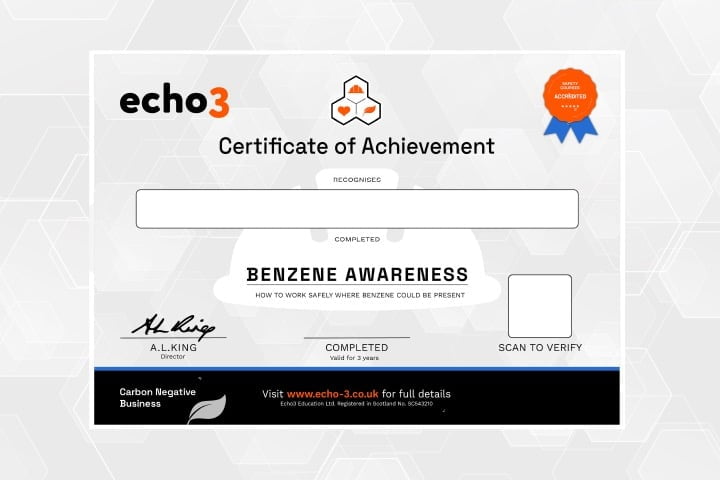


The Echo3 Benzene Awareness course is an online training course designed to help workers understand the risks associated with benzene exposure. It covers where benzene is found, how it can affect health, and the control measures needed to work safely in environments where benzene may be present. CPD-accredited certificate emailed on completion.


Benzene is one of the most hazardous chemicals found in industrial workplaces. It is a known human carcinogen, linked to serious conditions including leukaemia, anaemia, and other blood disorders. Exposure can occur through inhalation or skin absorption, and its highly flammable nature makes safe handling and storage essential.
Without proper training, workers can be unknowingly exposed to harmful levels of benzene. The risks are often not immediately visible, but the long-term health effects can be severe and, in some cases, fatal.
This online Benzene Awareness course helps organisations reduce the risk of occupational illness, meet their responsibilities under COSHH and UK health and safety legislation, and demonstrate a clear duty of care. It also ensures you have the training records needed for audits, inspections, and compliance checks.
Benzene exposure is difficult to detect at low levels, and its most serious effects may take years to develop. By the time symptoms appear, significant harm may already have occurred.
That’s why Benzene Awareness training online is essential. It gives learners the knowledge to recognise hazards early, understand how exposure happens, and follow safe working practices in real situations. Just as importantly, it prepares them to respond quickly and correctly if something goes wrong.
This not only protects individuals, but also reduces risk across your organisation and helps safeguard your reputation.
This online Benzene Awareness course (UK) provides a clear and practical understanding of benzene and how to work safely around it.
Learners are introduced to where benzene is commonly found in industry and the short- and long-term health effects associated with exposure. The course explains how benzene enters the body and why it presents both a health risk and a fire hazard.
It also covers the key requirements of COSHH and how these apply in everyday work, including safe handling, storage, and transfer procedures. You’ll gain an understanding of appropriate PPE, as well as how to respond to spills, leaks, or accidental exposure. Reporting and record-keeping requirements are also explained to support compliance.
By the end of the course, learners will have the knowledge needed to minimise risk and work safely in environments where benzene is present.
This online Benzene Awareness training course is designed for anyone who may work with or around benzene as part of their role.
It is particularly relevant for those working in oil, gas, and petrochemical industries, as well as refinery, chemical plant, and laboratory environments. It is also suitable for workers involved in manufacturing, industrial cleaning, maintenance, inspection, confined spaces, and waste handling.
The course is equally valuable for supervisors, site managers, and health and safety professionals responsible for COSHH compliance, as well as contractors operating on industrial sites.
No prior experience is required, making it suitable for both new starters and experienced workers who need a refresher.
This Benzene Awareness course online is CPD-accredited, providing recognised and trusted training across the UK.
It supports learners in identifying benzene hazards, applying safe working practices, and understanding their responsibilities under health and safety legislation. For employers, the certification provides clear evidence of compliance, supporting audits, inspections, and contractor pre-qualification.
On successful completion, learners receive a CPD-accredited Benzene Awareness certificate.
The certificate is issued digitally, can be downloaded or shared instantly, and is securely stored within the Echo3 platform. This makes it easy to maintain accurate training records and demonstrate compliance whenever required.
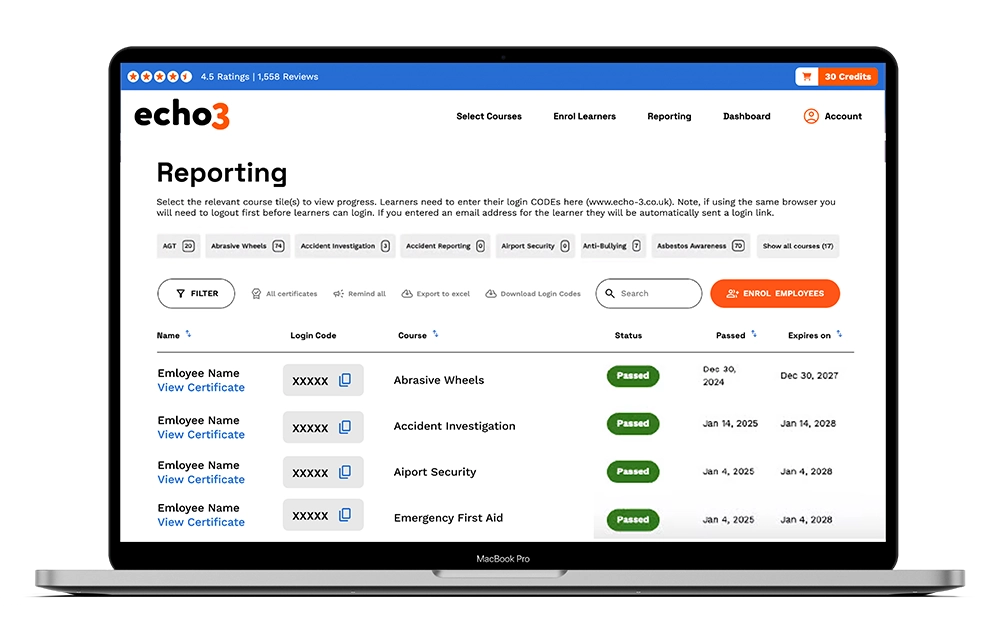
From a single, easy-to-use dashboard, you can enrol learners in seconds, monitor progress in real time, and keep accurate training records for compliance. Automated reminders help ensure certificates stay up to date, while downloadable reports make audits and inspections quick and stress-free.
Investing in this online Benzene Awareness course helps protect your workforce, reduce long-term health risks, and maintain full compliance with UK health and safety legislation.
For a more complete approach to workplace safety, this course can be combined with COSHH, Hazardous Substances Awareness, H2S Awareness and Health and Safety Awareness training to build a comprehensive programme that addresses a wide range of workplace hazards.
All Echo3 courses are available through Echo3 Training Credits, giving you a flexible, cost-effective way to scale training across your organisation.

Your certificate is emailed the moment you pass. Employers, agencies and auditors scan the QR code to check it on the spot.
Written in accordance with the Control of Substances Hazardous to Health Regulations 2002 (COSHH). Last updated October 2024.
Get Certified · £10.00 + VATAt Echo3 we design our courses around how people actually learn. The content is concise, free from unnecessary repetition, and supported by motion graphics to help explain key concepts. This enables workers to train efficiently, stay engaged, and ultimately stay safe at work.

 The Echo3 Benzene Awareness course is an online training course designed to help workers understand the risks associated with benzene exposure. It covers where benzene is found, how it can affect health, and the control measures needed to work safely in environments where benzene may be present. CPD-accredited certificate emailed on completion.
Benzene Awareness training is suitable for anyone who may be exposed to benzene in the workplace. This includes workers in oil and gas, petrochemical industries, manufacturing, laboratories, maintenance, and waste handling, as well as supervisors and health and safety professionals responsible for COSHH compliance.
If you are exposed to benzene, it can be hazardous to your health, so it is important to understand the types of exposure and impact.
Benzene can be absorbed into your body in three different ways: you can inhale it; you can absorb it through your skin; and you can ingest it.
If you ingest benzene in food or drink, you may feel a burning sensation in your digestive tract. You may also experience vomiting, tiredness, convulsions and a rapid or irregular heartbeat.
If you inhale benzene your lung tissue may be damaged. This can cause coughing, a hoarse voice and difficulty breathing. Exposure to large amounts can cause swelling of the airways and a build-up of fluid in the lungs.
If benzene comes into contact with your skin, it may cause redness, irritation and swelling, especially to the eyes and nose.
Duration of exposure will affect how your health is impacted.
If exposed to high concentrations, even once, you may experience headaches, tiredness, tremors or dizziness. If exposure is very high you may become unconscious or die.
If exposed to lower levels over a longer period, you may be at risk of bone marrow suppression, which affects the production of red blood cells. This can cause serious blood disorders such as Anemia. You may develop blood related cancers, such as Leukaemia or other cancers such lymphoma and multiple myeloma.
Benzene can weaken your immune system making you more susceptible to infections. Chronic exposure may affect the reproductive system. It can also cause cognitive impairment and changes in behaviour.
Remember, some of the symptoms may be delayed, so remain vigilant and, if in doubt, seek medical advice.
Benzene occurs naturally in crude oil, crude oil vapours, natural gas and some ground waters. It can also be released during natural processes such as volcanic eruptions and forest fires.
However, benzene in the general environment is mostly the result of human activity. Benzene can contaminate air, water and soil as a result of emissions, spills, or improper disposal practices. Car exhaust fumes are major contributors, along with petroleum manufacturing and other industries.
In an industrial setting, you may be exposed to benzene if you work within an oil refinery, chemical and petrochemical plants or coke works and foundries. You may also be exposed if you are involved in the storage and distribution of benzene.
Yes, this online Benzene Awareness course is fully accessible online and can be completed at your own pace. It can be taken on desktop, tablet, or mobile, making it a flexible option for individuals and organisations.
While there is no standalone law requiring a specific “Benzene Awareness course,” UK regulations such as COSHH require employers to provide adequate training and information to anyone exposed to hazardous substances, including benzene.
Yes, on successful completion of the online Benzene Awareness course, learners receive a CPD-accredited certificate. This can be downloaded, printed, and used as evidence of training for compliance and audit purposes.
This course covers key topics including benzene properties, health risks, routes of exposure, COSHH regulations, safe handling procedures, PPE, and emergency response actions. It provides a practical understanding of how to reduce risk in real working environments.
Yes, the course is designed to be accessible for both new starters and experienced workers. No prior knowledge is required, and the content is structured to build understanding step by step.
Benzene is highly dangerous because it is both toxic and flammable. Long-term exposure has been linked to serious health conditions, including cancer, while short-term exposure can cause dizziness, drowsiness, and irritation. Its risks are often not immediately obvious, making awareness training essential.





 Guaranteed Safe & Secure checkout managed by Stripe & Paypal








Have any questions about our training or services?
Email us at info@echo-3.co.uk today!
Get in touch