










Fire Marshal Course
Become a competent Fire Marshal or Fire Warden. This online Fire Marshal Course by Echo3 is designed for anyone responsible for fire safety in the workplace. Whether you’re newly appointed or refreshing your knowledge, this training provides the knowledge you need to carry out your duties effectively and safely.
Under the law, every workplace must have a designated ‘responsible person’ who ensures compliance with fire safety duties. This person may be supported by ‘competent persons’, a role typically fulfilled by Fire Marshals or Fire Wardens.
Fire Marshals play a critical role in day-to-day fire prevention and in ensuring the safe evacuation of staff during emergencies. To be effective, they must receive appropriate training that qualifies them as ‘competent’ under fire safety legislation.
This Echo3 course is suitable for anyone appointed as a Fire Marshal or Fire Warden. Its objective is to equip learners with the knowledge and confidence needed to help prevent fires and protect lives should an emergency occur.
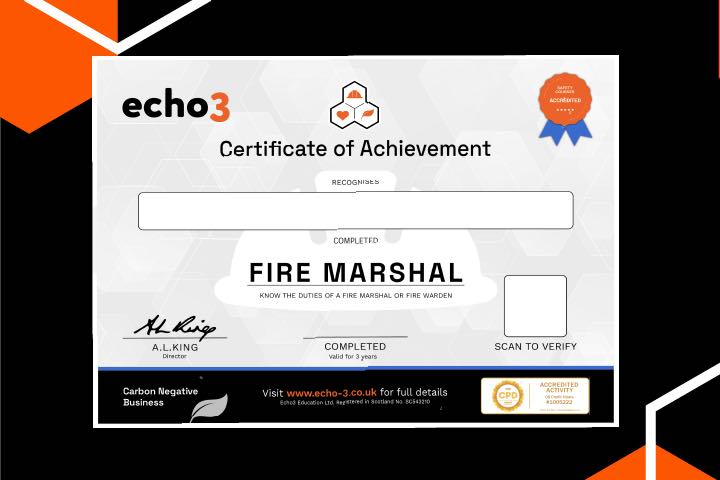
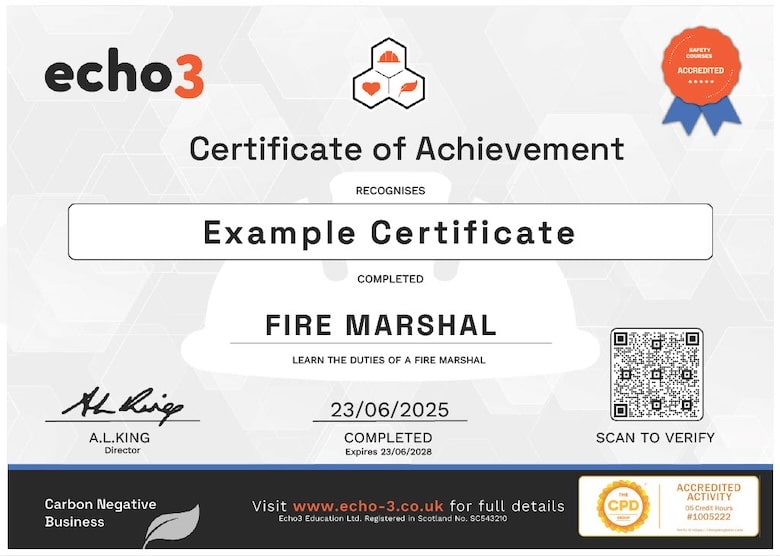
Fire Marshal Course Certificate
- Written in compliance with the Regulatory Reform (Fire Safety) Order 2005 & Fire (Scotland) Act 2005
- Developed by qualified health and safety professionals
- Accredited by CPD – learn more about CPD here
- Last Updated February 2024
- The online Fire Marshal certificate is valid for 3 years.
Course Preview
At Echo 3 we design our courses around how people actually learn. The content is concise, free from unnecessary repetition, and supported by motion graphics to help explain key concepts. This enables workers to train efficiently, stay engaged, and ultimately stay safe at work.
Frequently asked Questions
Who should take this course?
This course is ideal for anyone who:
- Has been appointed as a Fire Marshal or Fire Warden
- Assists a workplace‘responsible person’ with fire safety duties
- Needs to meet legal training requirements under UK fire safety law
What are the UK Fire Safety laws?
UK Fire Safety laws begin with the Health and Safety at Work act from 1974 that requires organisations to provide information, instruction, training, and supervision as necessary to ensure, so far as is reasonably practicable, the health and safety at work of its employees.
Fire regulations differ slightly across the home nations, but the duties listed above remain consistent. See below for links to specific legislation.
- In England & Wales the Regulatory Reform Order 2005 applies.
- In Scotland there is the Fire Act 2005 and the Fire Safety Regulations of 2006.
- And, in Northern Ireland the Fire Safety Regulations Northern Ireland (2010).
The main difference between these laws is how the ‘Responsible Person’ role is defined. In England and Wales & NI it’s a person. While in Scotland it’s an organisation.
What do UK Fire Safety laws require?
Under all 3 UK Fire Safety laws the ‘responsible person’ has legal duties to:
- carry out a fire risk assessment of the premises and review it regularly
- tell staff or their representatives about the risks they have identified
- appoint one or more competent persons (usually Fire Marshals) to assist them in undertaking their duties. There are two exceptions (Article 18 of the Fire Safety Order 2005). Self-employed employers with sufficient training. Or partnerships where are least one individual has sufficient training.
- put in place, and maintain, appropriate fire safety measures
- plan for an emergency
- provide Fire Safety information, fire safety instruction and training to staff
What is the difference between a Fire Marshal and Fire Warden?
Fire safety regulations require ‘competent people’ to assist the person who has overall responsibility for fire safety in carrying out fire safety measures.
These ‘competent people’ include fire marshals or fire wardens.
Often there is no difference between the role and responsibilities of a fire marshal and fire warden. These are simply two different terms for the same thing.
Occasionally, larger organisations appoint both fire marshals and fire wardens. This is a choice of the individual business rather than a requirement under the regulations.
In this case, fire wardens tend to have a pro-active fire safety role, taking responsibility for day-to-day fire management duties such as spot checks and fire risk assessments, and fire marshals will have a more re-active fire safety role, with responsibility for emergency response in the case of a fire in the workplace.
What are the duties of a Fire Marshal?
The main role of a fire marshal is helping the ‘responsible person’ in meeting these duties and preventing fires occurring.
Specific Fire Marshal duties will be outlined by individual organisations Fire Risk Assessment but typical duties of a fire marshal include;
- Checking fire safety equipment like alarms and extinguishers are always in good working order.
- Ensuring fire doors are closed and emergency exits are clear
- Ensuring staff know what to do in the event of a fire.
- Conducting fire drills and roll calls at the fire assembly point.
- Ensuring safety control measures detailed in the the fire risk assessment are always followed
- Maintain a Fire Marshal kit close to hand in case of a fire.
- Assist staff during an evacuation
- Keep an eye out and resolve any unsafe behaviours. For example poorly maintained electrical equipment.
What should be in a Fire Marshal’s kit?
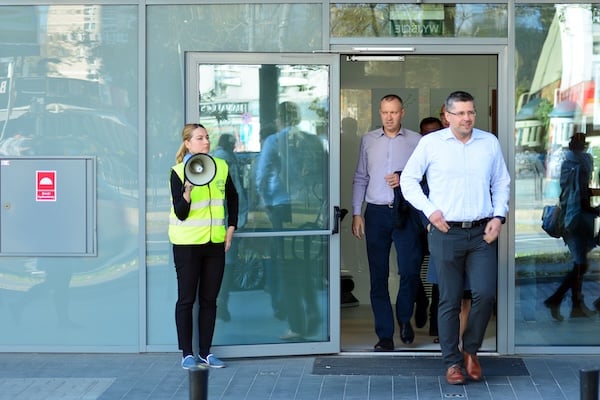
A Fire Marshal Kit, or fire emergency bag, contains equipment to assist in clearing a building of staff and public, to identify the Fire Marshal, to mark cleared areas and to help ensure no one re-enters the building. Fire Marshals should keep a kit bag easily accessible in case of a fire.
Recommended equipment in a Fire Marshal Kit bag includes:
- Megaphone – complete with batteries
- Emergency whistle – to help navigate colleagues where visibility is poor.
- Non-flammable gas airhorn – to help raise the alarm
- High visibility fire marshal vest – so you can be easily identified
- Identifiable safety helmet – so you can be easily identified.
- Fire Marshal identification arm band – so you can be easily identified
- Safety light-sticks – to help illumination of evacuation route
- Hazard Barrier Tape – to help prevent re access to the building until it is safe
What are the most common causes of workplace fires?
Fires don’t just happen. They are mostly caused by people in one or more of the following ways:
1. Accidentally – by what you do.
2. By omission or carelessness – by what you don’t do. Carelessness and a disregard for fire safety are fire hazards. Remember, fire safety is everyone’s responsibility.
3. Deliberately – by arson. Unfortunately, around 18 percent of fires are started deliberately. So report any suspicious behaviour or activity.
These factors manifest themselves in a few key areas. Faulty or poorly maintained electrical equipment is the cause of around a quarter of workplace fires.
Heating appliances, human error, flammable substances and improper storage of combustible materials are other common causes.
What are Echo3 Bridging Activities?
The Echo3 Fire Marshal course online includes bridging activities.
Online is great for imparting knowledge and best practice. Skills and experiences are another part of training that Echo3 Bridging Activities are designed to incorporate. So now our online courses can be easily customised to your workplace and include useful experiences.
Essentially Bridging Activities are locations that the learner must go to to complete the course. For example, ‘go to your Fire Assembly Point’, or the ‘Fire Extinguisher for oil-based fires’ or the closest ‘fire alarm call point’.
With the Echo3 Fire Marshal course administrators can select from a list of various Bridging Activities.
Once selected these activities appear at the end of the learner’s course. Administrators just need to place QR codes that we provide at the correct locations.
Once the learner arrives, they simply scan the QR code. This displays a number to add to the course and compete the activity.
Course Content
Assessment
- Complete a 20-question, multiple-choice quiz at the end of the course
- Achieve a minimum score of 80% to receive your certificate by email
- Free unlimited retakes — revisit the course and retry the quiz if needed
- A posted certificate is available for £9
- The Echo3 Fire Marshal certificate is valid for 3 years
- Complete a 20-question, multiple-choice quiz at the end of the course
- Achieve a minimum score of 80% to receive your certificate by email
- Free unlimited retakes — revisit the course and retry the quiz if needed
- A posted certificate is available for £9
- The Echo3 Fire Marshal certificate is valid for 3 years
How to Get Certified in 3 Steps
Individual Learners


Benefits for Individuals
-
 Engaging video-based content
-
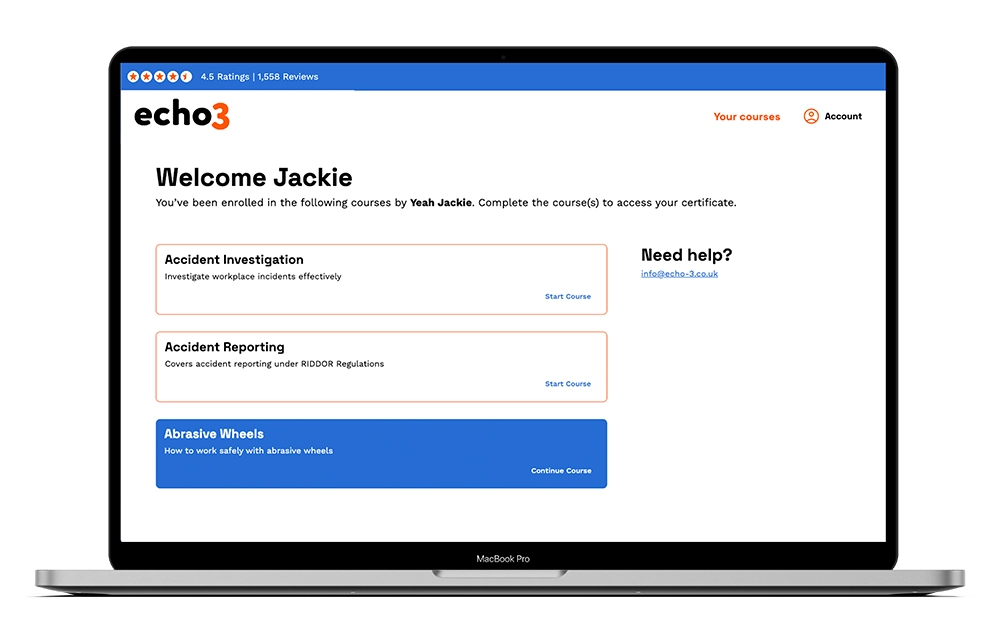
Learner dashboard included
-
Instant access after payment
-
Free course retakes
-
Shareable digital certificate




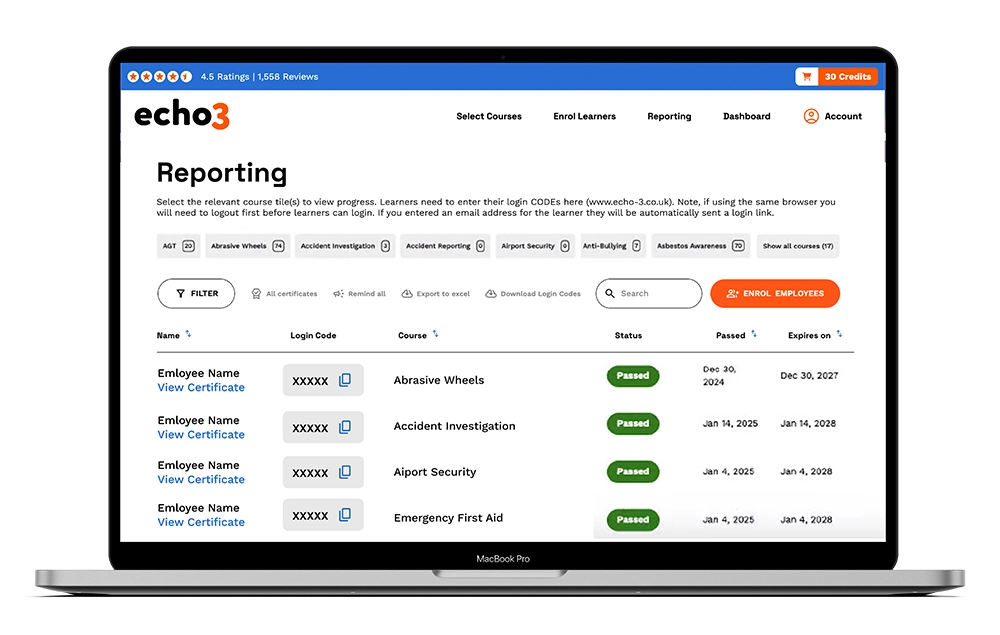


Bulk Buying Discounts
 Guaranteed safe & secure checkout managed by Stripe & Paypal


Related Courses
-
 £10.00 + VAT

-
£15.00 + VAT
-
£15.00 + VAT
-
£10.00 + VAT
-
£15.00 + VAT
-
£15.00 + VAT